

politics
Process Over Outcome: The Professional Trader’s Mindset
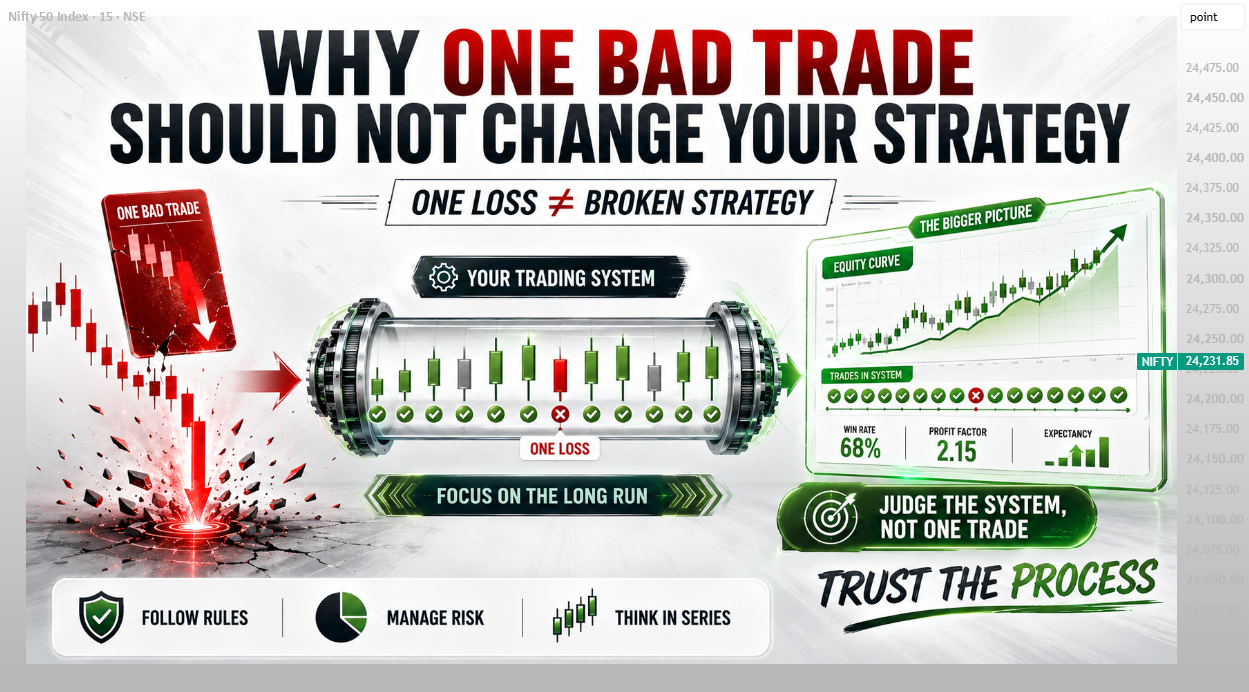
📊 Why One Bad Trade Should Not Change Your Strategy A losing trade can immediately make you question everything. “Was my setup wrong?” “Is my stop too tight?” “Should I add another indicator?” “Do I need a new strategy?” But one losing trade gives you very little information about whether a trading system actually works. A strategy should be judged across a **series of trades**, not one outcome. ------------------------------------ 📊 **A Good Strategy Still Loses** Suppose a strategy has: • 50% win rate • Average winner = 2R • Average loser = 1R It can still experience: • Several losses in a row • A losing week • False breakouts • Temporary drawdown That does not automatically mean the edge has disappeared. Losses are part of probability. ------------------------------------ 📊 Process and Outcome Are Different After every trade, ask: Did I: ✅ Follow the setup? ✅ Wait for confirmation? ✅ Use correct position size? ✅ Respect my stop? ✅ Follow management rules? If yes, a losing trade may simply be: **Good Process + Bad Outcome** That is completely different from a trade lost because the rules were broken. ------------------------------------ 📊 System Loss vs Execution Mistake A **system loss** means: • Setup was valid • Rules were followed • Risk was controlled • Trade simply failed Accept it. An **execution mistake** means: • Entry was early • Confirmation was missing • Position was oversized • Stop was moved • Trade was chased Correct the behaviour. Do not redesign the strategy to solve a discipline problem. ------------------------------------ 📊 Why Immediate Strategy Changes Are Dangerous After one loss, traders often change: • Entry rules • Stop-loss • Indicators • Timeframes • Targets Then another loss appears and they change everything again. Soon there is no consistent system left to evaluate. If the rules keep changing, your historical results become almost meaningless. ------------------------------------ 📊 Think in Samples Do not ask: “Did the last trade work?” Ask: “How has this setup performed across 50–100 correctly executed trades?” Track: • Win rate • Average winner • Average loser • Expectancy • Drawdown • Losing streaks • Market conditions • Rule-following One trade is a data point. A meaningful sample provides evidence. ------------------------------------ 📊 When Should You Review the Strategy? Review it when repeated evidence appears, such as: • Win rate deteriorating over a meaningful sample • Average winners shrinking • Average losses increasing • Drawdown exceeding normal levels • Market regime changing • One condition repeatedly causing failure Then use: **Review → Test → Modify → Retest** Not: **Lose → Panic → Change** ------------------------------------ 📊 **Do Not Optimize for the Last Trade** Suppose your stop is hit before price moves toward your target. It may be tempting to widen the stop next time. But ask: “Would this wider stop improve the complete historical sample?” If the answer is unknown, do not change the rule because of one painful outcome. ------------------------------------ 📊 Use a Process Score After each trade, score: • Setup quality • Entry discipline • Position sizing • Stop discipline • Trade management You can have: **Process Score = 100 Trade Result = −1R** That can still be a professionally executed trade. ------------------------------------ 📊 **Simple Formula** One Loss + Rules Followed = Normal Variance Repeated Weakness + Large Sample + Evidence = Strategy Review But: One Loss + Emotion + Immediate Rule Changes = Strategy Instability ------------------------------------ 📊 **Finally, the important point to note is:** One bad trade should not have the power to rewrite your entire strategy. Your system was built for a **series of trades**, not one prediction. Execute the plan. Record the result. Review the sample. Improve only when the data gives you a reason. Do not let one outcome overpower a process designed for hundreds of trades. ------------------------------------ Educational Purpose Only.
Read full article on Tradingview
Related News